Rosor Exploration

For exploration leadership

What flying first is worth to the program.

Your team is asking for a geophysical survey. Here is the case for approving it, argued in the terms you answer to. It comes down to budget discipline, de-risked drilling and a program the board can defend.

Those two figures are the same money: 6.7% of the total budget, 7.1% of the drilling left after it is paid for. It is the line item that decides where the rest of the money goes, and approving it aims spend you have already committed.

Survey share
6.7% of drill budget
Targeting must beat
7.1%
One 150 m hole
$45,000
Turnaround
15 avg business days

The economics

What does the survey cost against the drilling it aims?

All-in diamond drilling runs about $300 per metre, so a 150 m hole spends $45,000. A survey is 6.7% of that budget, and recovering it asks your hit rate to improve by 7.1% over what it would have been without one.

  1. 01

    $300/m all-in

    That is the typical all-in cost of diamond drilling, counting rig, crew, logistics and assays. Every metre carries it, aimed or not, so a 150 m hole is $45,000 before anyone reads the core.

  2. 02

    33 holes, or 31

    A $1.5M budget buys 33 holes if all of it goes to metres. Pay for the survey first and it buys 31. That is the entire cost of knowing where to put them.

  3. 03

    A 7.1% better hit rate

    That is the bar. Those 31 aimed holes have to return 7.1% more hits than 33 unaimed ones would, which on this program is two to three additional intersections. The rest is carried by a dataset you keep and reuse.

Stage fit

Which company are you, pre-drill or drill-targeting?

The survey plays a different role depending on where your program sits, and the approval case changes with it.

The two columns are the same company at different stages. The approval case is written differently for each.

What the survey buys

Early-stage
Ranked drill targetsA magnetics-led dataset turns a land package into a program investors can underwrite.
Drill-stage
Fewer holes to a hitThe survey guides the program along strike and at depth instead of stepping out on geology alone.

What the market pays for

Early-stage
The next raiseSurvey-derived targets are the substance you take to market.
Drill-stage
IntersectionsThe market pays for intersections, not metres.

What approval changes

Early-stage
Ground becomes a programThe targets are the story you raise against, and they arrive before the first hole.
Drill-stage
Committed metres get aimedThe spend already sits in the budget. The survey decides where it lands.

Diligence

How does this show rigor to the board?

A survey-led program is auditable. It is designed with your geologists, quality-controlled on site and documented to the standard your disclosures run on.

  1. 01

    A disciplined program, on record

    Survey design is worked out with your technical team before anything flies, and it covers line spacing, orientation and sensor selection. The board sees a method it can question and a design it can point to.

  2. 02

    Data validated before the crew leaves

    Data-quality metrics are reviewed daily and acquisition is adjusted while the survey is underway. The dataset your team interprets was checked on your ground, and nobody finds it broken weeks later on the processing bench.

  3. 03

    Documentation that survives review

    Deliverables arrive with the processing record, the interpretive report and the sign-off that NI 43-101-grade technical disclosure expects. That paper trail holds up under a qualified person's review.

Proof

Programs that ran this way

Published programs come with the numbers and the client's own words.

Drone magnetics
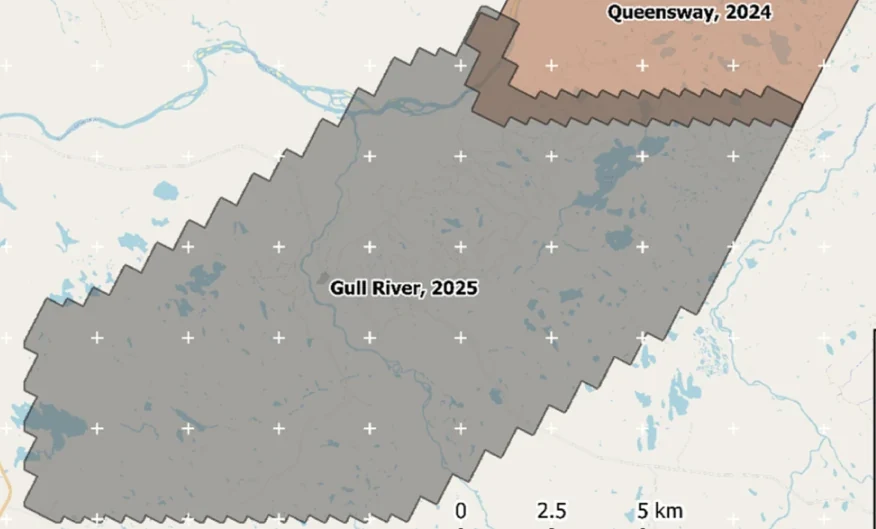
New Found Gold — Gull River survey figure

Gull River

Grand Falls-Windsor, Newfoundland

New Found Gold
315
line-km/day on this program
~4,000
line-km completed

Almost 4,000 line-kilometres acquired across the program, completed on schedule despite delays from a wildfire evacuation interrupting it and geomagnetic storms. Sustained production without trading away data quality.

“The drone magnetic survey provided high-resolution structural insights that significantly improved our understanding of the subsurface geology, allowing us to refine our exploration targets.”

David Drover · Project Geologist

Read the Case Study →

Drone magnetics
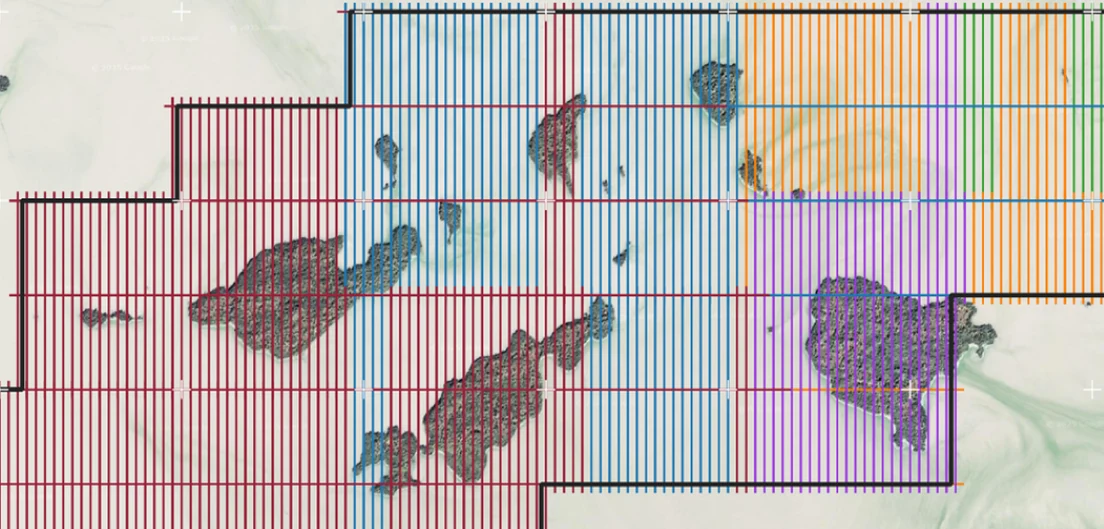
International Explorers & Prospectors — Abitibi Lake survey figure

Abitibi Lake

Abitibi Lake, Ontario, Canada

International Explorers & Prospectors
10
days, site to deliverables
3
days of acquisition

Mobilization to final deliverables in ten days, with acquisition complete in three and no mechanical downtime.

“Throughout the duration of the project, Rosor maintained clear and efficient communication with our team. They demonstrated a strong commitment to meeting deadlines by processing the collected data within a very tight time-frame, ensuring that our exploration schedule remained on track.”

Peter Colbert · CFO

Read the Case Study →

FAQ

Straight answers

01

Why not just put the budget into more drilling?

Because undirected metres are the expensive part of a program. At $300/m all-in a 150 m hole spends $45,000, and a survey is only 6.7% of the drilling budget it aims. Recovering it asks targeting to improve 7.1%, which is two to three intersections in a 31-hole program. The survey does not compete with drilling. It decides where the drilling goes.

02

What does the board actually see from this spend?

The board sees a documented, defensible program. Survey design is signed off with your geologists, on-site quality control goes on record, and ranked drill targets arrive with geoscientist sign-off in NI 43-101-grade deliverables. A champion can hand that package upward, and it stands up in a technical report.

03

How does this de-risk flow-through spend?

Flow-through dollars have to be spent on qualifying exploration inside a window, and they have to be spent well. A survey-led program directs those dollars at ranked targets instead of untargeted step-outs, and the documentation trail shows the money was deployed under a disciplined method.

04

How fast can this happen once approved?

Send a shapefile and you will have a quote inside a week, and we mobilize on a contract. Deliverables arrive within an average of 15 business days of completion. Approval this quarter can mean targets in this field season.

Talk to an expert

Send us the ground your team wants flown.

A shapefile and a target model are enough. We will come back with a coverage plan and a budget range inside a week, and we mobilize on a contract.

Send us your shapefile. We'll come back with a preliminary read, a coverage plan and a budget range.